Focused Ultrasound
Focused Ultrasound: A New Non-Invasive Treatment for Essential Tremor
Understanding Essential Tremor
Approximately 5–7 million people in the United States and over 60 million people worldwide struggle with essential tremor (ET), one of the most prevalent movement disorders. It results in uncontrollable shaking, usually in the hands, that can make daily activities like writing, eating, and drinking exceptionally hard. Nearly seven out of ten ET patients endure mood symptoms like depression because living with a tremor can be extremely frustrating. magazine.hcahealthcare.com. An innovative FDA-approved, incisionless procedure called MRI-guided focused ultrasound (MRgFUS) may be an option to reduce your symptoms and improve your quality of life if medications aren’t effective in managing your tremor.
How Focused Ultrasound Works
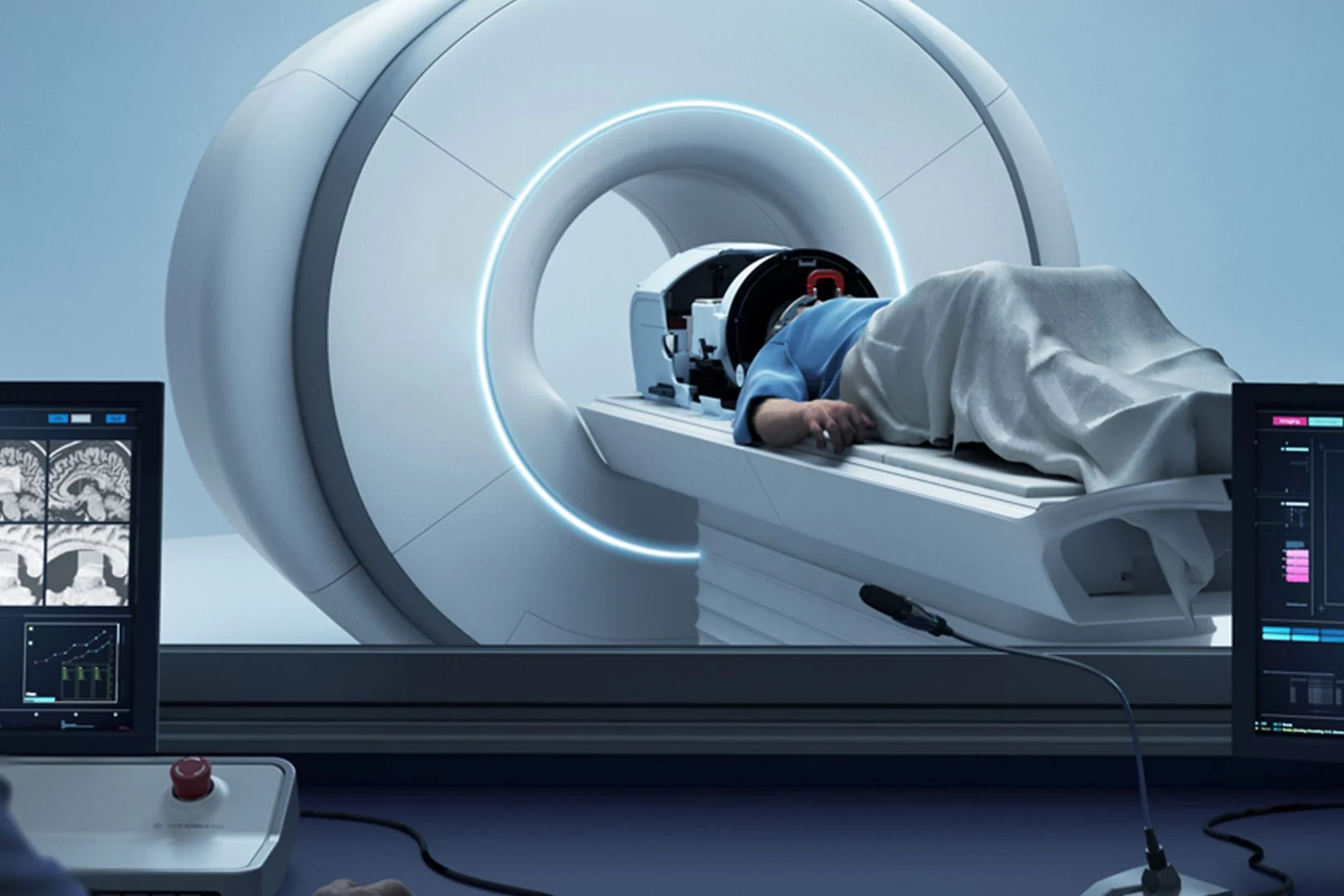
To stop tremor signals, the MR‑guided focused ultrasound uses thousands of small ultrasound beams focused on a precise spot in the brain. The patient wears a specially-designed lies on an MRI table (awake, without general anesthesia) wearing a specially-designed helmet filled with cooling gel. The MRI provides live images so the doctor can target the exact brain location that’s causing the tremor. Over 1,000 ultrasound beams then converge on that target, gently heating it to create a very small, controlled lesion. Because each beam is too weak to affect normal tissue on its own, only the focused spot in the brain gets hot enough to stop the abnormal tremor signals. There are no scalp cuts or implants – the treatment is entirely incision-free.
Many patients notice tremor improvement right away. The energy is delivered gradually: the surgeon will first apply low-energy test pulses, asking you to perform simple tasks (like drawing a spiral or touching your finger to your nose) so they can see if the tremor is improving and check for side effects. Once the correct spot is confirmed, the ultrasound power is increased to create the final lesion and stop the tremor. You stay awake during this 2–3 hour outpatient procedure, and you can give feedback the whole time, which helps the doctor fine-tune the treatment. Many patients feel their tremor lessen even before the procedure is over.
Benefits of Focused Ultrasound Treatment
Focused ultrasound offers several advantages over traditional brain surgery or implants:
Highly Precise: MRI guidance and focused sound energy target only the tiny area of brain causing the tremor, leaving surrounding tissue unharmed.
Incision-Free: There are no cuts in the scalp or skull and no implanted hardware. This means a much lower risk of infection and no scar.
No General Anesthesia: The procedure is performed while you are awake (though mildly sedated and relaxed). You can talk with the medical team throughout.
Outpatient Procedure: You will be in the MRI suite for a couple of hours, and most patients go home the same day.
Immediate Relief: Many people experience tremor reduction during or immediately after the procedure. By three months, tremors are often 50–70% lower than before treatment.
Quick Recovery: Because there are no incisions or hardware, recovery is fast. Most patients resume normal daily activities within a few days.
Long-Lasting Results: A 5‑year follow-up study showed that tremor reduction remains substantial (over 70% improvement) with no late complications.
Overall, focused ultrasound is FDA‑approved and has a strong safety record. It avoids many of the risks of open brain surgery. (As with any treatment, there are possible side effects: some patients experience mild headache, nausea, or temporary numbness/tingling, and a small percentage may have longer-term balance or sensory changes. Be sure to discuss risks with your doctor.)
Am I a Candidate?
This treatment is intended for people who have essential tremor (or tremor-dominant Parkinson’s disease) that is causing significant problems and has not been controlled by medication. You might be a candidate if:
You have a confirmed diagnosis of essential tremor or tremor-dominant Parkinson’s disease.
Your tremor interferes with everyday tasks (writing, eating, etc.) and has not sufficiently improved with medication.
You have tried at least two tremor medications but are still symptomatic.
You are in generally good health and can undergo an MRI scan.
Certain conditions may make focused ultrasound unsuitable: for example, having non-MRI-safe implants (like certain metal pacemakers or brain shunts) or severe brain abnormalities can be a contraindication. Our team will review your medical history and imaging (a head CT/MRI is usually done as part of the evaluation) to see if this is right for you.
What to Expect During Treatment
You will be comfortably positioned lying on the MRI table. A special helmet-shaped device is fitted over your shaved head, with a water-cooled membrane to allow the ultrasound beams to pass through. Once everything is set up and in position, the MRI scans the brain to pinpoint the exact treatment target.
The procedure then proceeds in stages: short bursts of low-energy ultrasound (called sonications) are delivered to the target area. After each burst, you may be asked to perform tasks (for example, drawing, reaching, or touching your finger to your nose) to test how the tremor responds. This step-by-step feedback allows the physician to confirm the right location. If everything looks good, the ultrasound power is gradually increased to create the final, therapeutic lesion and stop the tremor.
Throughout the treatment (which typically takes 2–3 hours), your vital signs (heart rate, blood pressure, oxygen) are monitored closely. You will remain awake the whole time, but medicine will be given through an IV if needed to keep you comfortable. Many patients notice their hand tremor is greatly reduced or even gone before the procedure ends. After the final sonication, the equipment is removed and you are taken to a recovery area for monitoring.
Recovery and Follow-Up
After the procedure, you will rest briefly in recovery. Most patients are able to leave the hospital or center a few hours later, and return to normal activities within days. Since there are no cuts or hardware, there is no need for wound care or limits on lifting. You will have follow-up appointments with your neurologist and/or surgeon over the next few months to check progress. Typically, visits are scheduled around 1 month, 3 months, and 6–12 months after treatment.
Because focused ultrasound does not cure the underlying disease (essential tremor or Parkinson’s), the procedure may not eliminate all tremor indefinitely. Some patients experience a gradual return of mild tremor after a few years. However, studies show the benefits are long-lasting for most people, and if needed the procedure can be repeated on the opposite side several months later (treating one arm at a time).